
.png)
 1 hour ago
1
1 hour ago
1
ARTICLE AD BOX
• Centre, provinces struggle to reach consensus over fiscal space
• Federal govt seeks over Rs1tr for strategic needs; provinces resist freeze on NFC shares
• KP says demand could push provinces into deficit
• CM’s adviser says issue now political, not technical
• Seeks consultation with Imran before budget decisions
ISLAMABAD: The announcement of the federal budget 2026-27 remains uncertain as the federal government, its coalition partners and provincial governments struggle to reach consensus over the Centre’s demand for more than Rs1 trillion for strategic needs.
The meeting of the National Economic Council (NEC), officially called on Monday for June 8, was postponed for the third time at the last moment amid continuing negotiations over the freezing of provincial shares in the federal divisible pool under the National Finance Commission (NFC) award.
As a consequence, the federal budget 2026-27 may not be presented in parliament on June 10 as announced last week by the Ministry of Finance. The finance ministry’s official spokesperson did not respond to a request for comment on the revised plan for the release of the Economic Survey of Pakistan and the budget schedule.
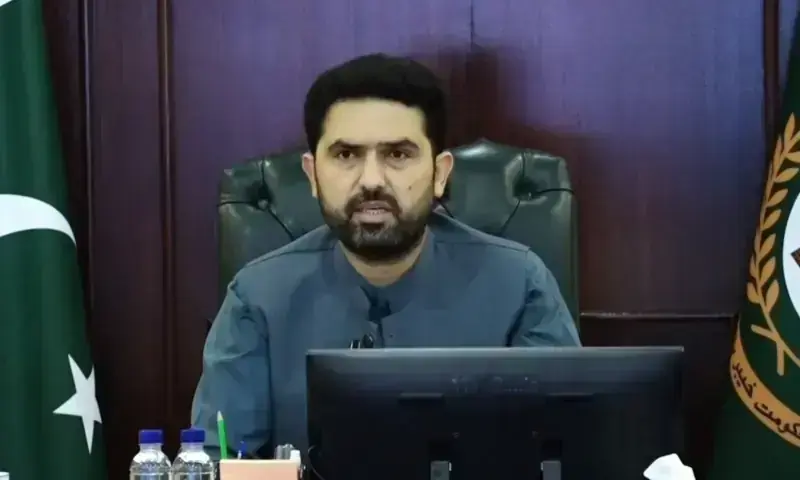
Muzzammil Aslam, adviser on finance to the Khyber Pakhtunkhwa chief minister, confirmed that the Centre had told provinces that their financial shares under the NFC for the current year would not be increased next year and that any amount above the current year’s share would have to be returned to the Centre.
Aslam said the provinces had protested the demand, as it would push provincial budgets into deficit and make it difficult for them to run their governments. He said the federal government team suggested that provinces could freeze salaries and limit development schemes.
The Centre’s additional fiscal demand is over and above the Rs1.95tr cash surplus that provinces have already committed and signed under the national fiscal pact pushed by the IMF.
Speaking to journalists after a meeting with a federal team led by Planning Minister Ahsan Iqbal and comprising Finance Secretary Imdadullah Bosal, Aslam said he had not seen such a precarious situation in the past 21 to 22 years that he had been following budgets, and certainly not during the last six to seven years in which he had been directly involved in the budget process at the federal and provincial levels.
The KP team was led by Chief Minister Sohail Afridi.
Aslam said even the rescheduled NEC meeting on June 9 was uncertain, as many issues that had developed over time were too significant to be settled ahead of the NEC meeting. As a result, the federal budget scheduled for June 10 could slip further, as there was “no way forward in sight” and consensus between the Centre and provinces appeared distant, he said.
He said even if provinces practically agreed to give up funds beyond their current year’s share, it would be technically challenging to implement the decision because it could violate surplus targets agreed with the International Monetary Fund.
Responding to a question about the constitutional bar on reducing provincial NFC shares during a fiscal year, Aslam said there was no clear answer on the table, but the Centre perhaps wanted to transfer funds to the provinces and then seek their return.
“Everybody is standing on their toes” to find a solution, he said, while acknowledging that the strategic purpose for the additional funding was in the national interest. “The demand for the strategic purpose is not unjustified and is in the national interest, but Sindh and Punjab will have to show generosity,” he said.
Aslam said KP’s fiscal loss could be Rs170 billion to Rs180bn compared to much larger demands from other provinces — around Rs700bn from Punjab and Rs500bn from Sindh. He said the issue had now become political rather than technical.
Therefore, he said, the matter was beyond the KP government’s powers and had to be taken up in consultation with PTI founder Imran Khan. For this purpose, he said, CM Afridi and he himself should be granted urgent access to Imran in Adiala Jail.
He said Imran was large-hearted and could provide a better solution, unlike the leadership of the current coalition partners.
Aslam said the delegation led by Iqbal was convinced about KP’s position and promised to return with answers regarding an urgent meeting with Imran.
Meanwhile, the Chief Minister’s Office said the delegation led by Iqbal had come to KP House “to discuss a range of intergovernmental matters, including meeting with former prime minister Imran Khan, the forthcoming meeting of the NEC, provincial fiscal and constitutional rights, development financing for the merged districts, energy-related issues, wheat supply, hydropower projects, and other matters of mutual concern”.
CM Afridi conveyed his government’s concerns over the continued unequal treatment of KP in fiscal allocations and development financing. He said sustained denial of the province’s constitutional and financial entitlements could adversely affect the environment necessary for constructive intergovernmental engagement, including participation in national forums such as the NEC.
He said consultations with Imran were essential in the context of major policy and budgetary decisions, noting that political parties routinely seek guidance from their leadership on matters of national importance.
Such consultations were “necessary before taking key decisions relating to the budget and broader economic policy”, he said.
The chief minister pointed to reductions in development allocations earmarked for Khyber Pakhtunkhwa and the merged districts. He said funding under the Accelerated Implementation Programme had been reduced from Rs37bn to Rs27bn, while development allocations for the merged districts had been cut from Rs66bn to Rs56bn within a week by the federal government. He said the NFC share of the merged districts had been withheld unconstitutionally for the past eight years, causing serious harm to development and public welfare efforts in these areas.
Afridi said KP produced more than 500 mmcfd of natural gas daily, yet the people of the province continued to face severe gas shortages and loadshedding despite KP’s total consumption of 150 mmcfd.
This was “contrary to constitutional requirements and the principles of equitable resource distribution”, he said, adding that depriving a gas-producing province of its rightful share was unacceptable. He also pointed to delays in operationalising a completed dam project in Swat due to the non-issuance of required clearances for Chinese engineers by the federal government, preventing the timely use of completed infrastructure and limiting associated economic benefits.
Similarly, the Peshawar Bus Terminal had been completed but remained non-operational due to the pending issuance of a no-objection certificate by the National Highway Authority, he said.
The CM’s Office said Iqbal assured the KP government that the no-objection certificate required for operationalising the Peshawar Bus Terminal would be facilitated within 24 hours. He promised that the concerns and proposals discussed during the meeting would be “presented before the prime minister and other relevant federal forums, and that efforts would be made to pursue their resolution”.
Published in Dawn, June 9th, 2026





 English (US) ·