
.png)
 1 hour ago
2
1 hour ago
2
ARTICLE AD BOX
• Budget delay exposes Centre-province fiscal deadlock
• NFC shares may be frozen under budget pressure
• Critics say Centre ignores revenues kept outside divisible pool
• Experts blame fiscal crisis on low tax collection, debt, federal spending
• Raza Rabbani warns of phased rollback of 18th Amendment, NFC Award
WHEN Finance Minister Muhammad Aurangzeb rises to present his third budget, the usual questions will apply. Which sectors face fresh taxation? Will the salaried class get any relief? How much will the cost of living increase? Who will get tax benefits, and who will not?
But this year, there is an additional dimension worth watching closely. Will the budget clip provincial finances? Will the Centre freeze provincial shares under the current National Finance Commission (NFC) arrangement and push fresh expenditure obligations onto provinces — over and above their existing requirement to produce a primary surplus?
If it does, it would amount to a unilateral revision of the NFC arrangement through the back door of the budget.
When parliament adopted the landmark 18th Amendment in 2010, it was meant to settle a long-running devolution dispute between the provinces and the Centre. The 7th NFC Award corrected decades of fiscal imbalance, giving smaller provinces — particularly Balochistan and Khyber Pakhtunkhwa — a larger stake in national revenues. It was a moment of rare political consensus. Fifteen years on, that settlement is being unravelled: not through a constitutional amendment or fresh consensus, but through pressure and demands that provinces simply hand the money back.
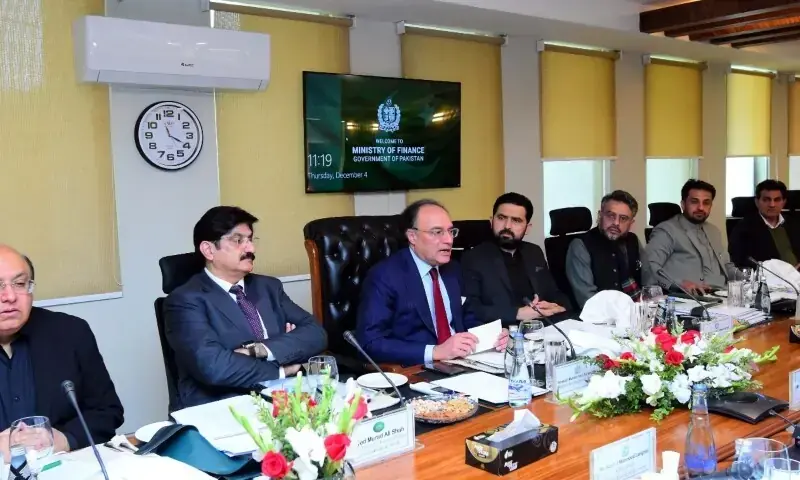
The announcement of Budget 2026-27 has been postponed twice as the Shehbaz Sharif government, its coalition partners and provincial governments struggle to agree on the Centre’s demand for additional funds of more than Rs1.2 trillion for strategic needs. The National Economic Council meeting, last called for June 9, was postponed for the fourth time amid continuing negotiations over the federal demand to freeze provincial shares in the federal tax divisible pool.
Former Pakistan chief economist Rashid Amjad called it a potential tragedy. “That [7th Award and 18th Amendment] is the best thing which has happened to Pakistan; it empowers provinces and strengthens the federation. They say they want to decentralise powers but they don’t want to give up power in the federal government,” he said.
‘Precarious situation’
Whatever is known about the contours of the federal government’s demand mostly comes from Muzzammil Aslam, finance adviser to the PTI government in KP, as the ruling PML-N and its principal coalition partner continue their discussions behind closed doors.
Aslam says the Centre told provinces their financial shares under the NFC for the current year would not be increased next year, and that any amount above the current year’s share would have to be returned to the Centre. This demand comes over and above the Rs1.95 trillion cash surplus that provinces have already committed under the National Fiscal Pact pushed by the IMF.
Aslam warned the move would push provincial budgets into deficit. “I have not seen such a precarious situation in the past 21 to 22 years that I have been following budgets,” he told journalists after a meeting with a federal team led by Planning Minister Ahsan Iqbal.
He acknowledged that “the demand for the strategic purpose is not unjustified and is in the national interest, but Sindh and Punjab will have to show generosity.” He also noted that the matter was beyond the KP government’s powers and required consultation with jailed PTI leader Imran Khan before any decision could be taken.
On the constitutional bar on reducing provincial NFC shares during a fiscal year, Aslam said there was no clear answer on the table — though the Centre perhaps intended to transfer funds to provinces and then seek their return, a workaround that raises serious questions of its own. As he put it, “everybody is standing on their toes” to find a solution, with no way forward yet in sight.
Also worth watching will be the PPP: what concessions it is willing to give, if any, and in exchange for what. Many believe the party has little room to refuse in the current political dispensation, with the coalition watching each move closely.
NFC rollback?
Proponents of the current NFC arrangement argue that the Centre’s posture did not emerge overnight. For years, Islamabad has pushed the narrative that the 7th Award — which hands 57.5 per cent of revenues to provinces — is the primary driver of its fiscal distress, leaving it unable to service debt, fund defence or complete strategic projects.
Critics say this narrative is built on selective accounting. By expanding non-shareable levies over the years, the federal government has quietly grown its own fiscal base while publicly lamenting its diminished share. “GST was replaced by a levy on petroleum products precisely so it wouldn’t go into the divisible pool. If it had remained GST, it would have had to be divided with the provinces,” said Ali Salman of the Policy Research Institute of Market Economy (PRIME).
A former Punjab finance secretary was equally blunt: “The NFC Award did not create the fiscal crisis; it inherited one. Debt and FBR dysfunction had crept into this system decades before provinces received a rupee more. Massive currency devaluation in recent years worsened this crisis. None of that has anything to do with how the divisible pool is split.”
Amjad identified the real squeeze. “When you are in an IMF programme, there are very strict macro-framework restrictions under which you work,” he said, adding that the government had compounded its difficulties by entering conflicts on multiple fronts simultaneously, driving federal expenses upward. “The only way you can square the circle is for provinces to take on more of the federal expenditures and run bigger surpluses.”
Salman noted that while the federal government bears a disproportionate fiscal burden, the revenue failure is shared. The NFC Award had set a target of bringing the tax-to-GDP ratio to 15 per cent within five years — a target the Centre never achieved, and one provinces did little to support either. “The abysmally low tax-to-GDP ratio of around 10pc is the core of the problem,” said Amjad. “The federal government must curtail its expenditures if it can’t raise tax revenues.”
Radical solutions?
Veteran PPP leader Raza Rabbani, who played a key role in building consensus on the 18th Amendment, warned that the Centre’s moves amounted to a gradual undoing of the constitutional order established in 2010. “They are rolling back the amendment in phases, and simultaneously the NFC Award, instead of reducing their own expenditure,” he said.
He pointed to devolved ministries still operating at the federal level as an obvious starting point, and called for cuts to civil bureaucracy perks. If the federal government was unwilling to take those steps, Rabbani proposed a more radical solution: hand over tax collection entirely to provinces, place federal expenditure before the Council of Common Interests, and have provinces contribute a proportionate share. “If they can’t put their own house in order, then they should stop tax collection altogether,” he said.
Rabbani reserved his strongest words for what he described as unprecedented IMF interference. “Based on my experience in politics, the level of IMF dictation regarding the budget is unlike anything I have seen before. This degree of micro-management of budget targets by the IMF is unprecedented,” he said, adding that the new fiscal targets being imposed on provinces also originated with the fund. “If parliament is to simply rubber-stamp an IMF budget, that is a different matter altogether.”
Whether provinces will ultimately cover the fiscal hole for Islamabad — and whether the Centre can build the consensus it needs — remain the central questions hanging over this budget season.
Published in Dawn, June 10th, 2026




 English (US) ·