
.png)
 6 hours ago
7
6 hours ago
7
ARTICLE AD BOX
Television drama's exploration of darker side of privilege comes as breath of fresh air that departs from typical Pak
KARACHI:
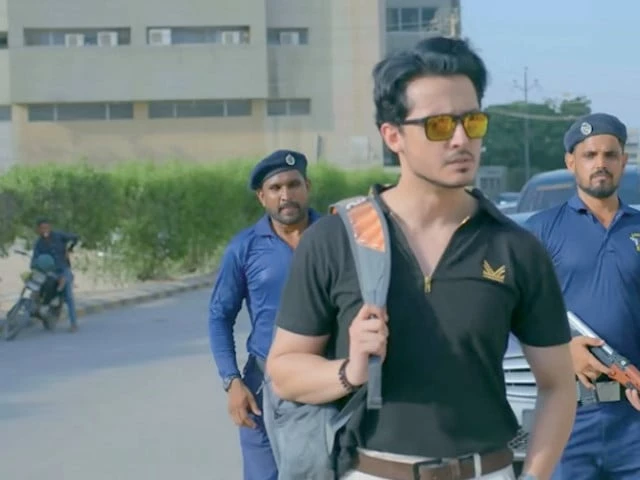
A man is killed on a road. The case makes headlines. Social media erupts with questions. Then, slowly, attention shifts elsewhere.But what happens when such incidents are not treated as isolated crimes, but as part of a larger pattern? That is the question at the heart of Shaandaar, a new crime thriller airing on Express Entertainment. The 16-episode drama, directed by Wajahat Rauf, draws inspiration from several real-life roadside killing cases that have sparked public debate in Pakistan. It is not a dramatisation of one specific incident. Instead, the story brings together elements from different cases involving violence, power and influential individuals. The result is a television drama that attempts to move away from the familiar formulas that dominate Pakistani television.There are no traditional family feuds at the centre of Shaandaar. Instead, the drama explores crime, privilege, power and the consequences of actions that can sometimes appear to have been buried by influence. The drama features an ensemble cast including Shamoon Abbasi, Shahzad Sheikh, Areeka Haq, Ali Dayan, Laila Wasti and Ahsan Afzal Khan. Its treatment is deliberately fast-paced, with the makers aiming to combine the tension of a crime thriller with the realism of stories inspired by events that have already entered public consciousness. For Ahsan Afzal Khan, who plays the central character Salar, the opportunity to work in such a genre was one of the main reasons he agreed to the project. "A script picked by Mr Wajahat Rauf already gives you the impression that something different is coming," Khan told The Express Tribune. He said Pakistani television rarely gets the opportunity to explore stories of this kind. "There are very few such stories," he said. "We were getting a chance to do something different a crime thriller genre." That difference, he believes, is one of the drama's biggest strengths.Khan describes Shaandaar as fast-paced, gritty and dark, but not without moments of lightness. The tone, he says, gradually changes as the story progresses. "There is a light mood too, then slowly it gets darker and darker," he said. "There are social messages and a lot of things." The actor also believes that the drama's pace is an important part of its appeal. "It keeps you interested," he said. "I watch the episodes myself. I watch them with my family and I feel like watching the next episode. It is not dragged." That response is particularly significant for Khan because, according to him, Shaandaar has brought him a new audience. "Teenagers and Gen Z are enjoying this drama a lot," he said. He also said that people who do not usually watch Pakistani dramas, and instead prefer international content, have shown interest in the series. That may be partly because the drama presents a world that feels closer to the crime thrillers many younger viewers already consume on international streaming platforms. At the centre of the story is Salar a character who is privileged, arrogant and powerful.He looks down upon others and misuses his influence. He is narcissistic and wants things on his own terms. But Khan says Salar is not written as a one-dimensional villain. "I hope people relate to the human side of Salar, but not to his entire personality," he said. The character may be difficult to defend, but the actor believes that understanding the reasons behind a person's behaviour is not the same as approving of it. "No negative character is a bad person, and no positive character is a good person," Khan said. "We are all layered somewhere." He argues that people are shaped by their experiences by what they see at home, what they face at school and how they are treated by those around them. "Did we face bullying? What did we face? All of that is incorporated into your mind," he said. "You are reacting as a defence mechanism." this is what makes Salar interesting. Beneath the arrogance and privilege, there is a human being with emotions and vulnerabilities. But those qualities do not erase the damage he causes. "He is privileged. He is arrogant," Khan said. "He wants what he wants."






 English (US) ·