
.png)
 11 hours ago
2
11 hours ago
2
ARTICLE AD BOX
Freelance remittances rise to $856m as 5G spectrum auction generates $509m

IT and services exports – already crossing the multibillion-dollar mark – are growing at a faster clip than goods and carry immense significance. Photo: file
KARACHI:
Pakistan’s Information and Communication Technology (ICT) and telecommunications sectors recorded notable growth during FY2026, according to the Pakistan Economic Survey unveiled on Thursday. ICT exports reached $3.388 billion, while the trade surplus in IT and IT-enabled services stood at $2.911 billion, reflecting a significant increase compared with the previous year. The government has highlighted these achievements as evidence of the sector’s resilience and growing contribution to the national economy. Freelancers’ remittances also rose to $856.3 million, indicating the increasing role of Pakistan’s digital workforce in earning foreign exchange. However, despite these positive indicators, the figures reveal deeper structural challenges. While export earnings have increased, Pakistan’s ICT sector still lags behind regional competitors in attracting large-scale foreign investment and developing high-value technology products. Much of the growth remains concentrated in outsourcing and freelance services rather than innovation-driven industries. The telecom sector generated Rs837 billion in revenues and expanded its subscriber base to 207.22 million, with broadband users reaching 161 million. Yet concerns persist regarding service quality, digital infrastructure and internet reliability. Businesses continue to report disruptions caused by inconsistent connectivity, which can undermine productivity and investor confidence. The survey also notes that the government earned approximately $509.6 million from a spectrum auction held in March 2026, inviting suggestions that revenue generation from spectrum sales should be accompanied by stronger commitments from operators to improve network coverage and service standards, particularly in underserved rural areas. Although over 5.14 million individuals reportedly received digital skills training, questions remain about the effectiveness of these programmes in creating sustainable employment opportunities. Analysts emphasise that training alone is insufficient unless matched by job creation, entrepreneurship support and stronger industry-academia collaboration. Read More: Pakistan Economic Survey: Economy expands to $452b, GDP grows 3.7% The Pakistan Telecommunication Authority (PTA) also reported generating approximately $509.6 million (approximately Rs142.6 billion) from its 5G spectrum auction conducted on March 10, 2026. Total telecom sector revenues stood at Rs837 billion for the period, with the sector contributing Rs285 billion to the national exchequer in taxes and duties. By March 2026, broadband subscriptions reached 161 million, driving total telecom subscriptions to 207.22 million and pushing overall tele-density to 82.6%. Despite the celebratory tone of the official data, the survey's launch argues that the numbers obscure deep structural imbalances and infrastructure failures that threaten the sector’s long-term sustainability. While the $856.3 million freelance footprint reflects strong individual entrepreneurial drive, it points out that the growth lacks institutional depth. The heavy reliance on standalone gig workers indicates a persistent failure to transition into high-value, corporate-tier enterprise software contracts. Without scaling up full-fledged IT companies, Pakistan’s digital export revenues will soon hit a hard structural ceiling. Furthermore, the highly publicised $509.6 million (Rs142.6 billion) 5G spectrum auction masks a cautious response from telecom operators because the auction framework allows for deferred licence payments and does not represent an immediate cash windfall to bridge the state’s fiscal deficit. “The upcoming budget should focus on enabling growth rather than increasing the burden on a sector that is already contributing significantly to exports and employment. With IT exports crossing $3.8 billion in just 10 months and growing at over 20% annually, the upcoming budget should treat technology as a strategic export industry,” Si Global CEO Dr Noman Ahmed Said told The Express Tribune. Also Read: Poverty rises to 28.9% despite economic recovery By prioritising technology education, IT financing, digital infrastructure, AI and cybersecurity skills, ease of doing business, and policy stability, Pakistan can attract greater foreign investment, create high-value jobs and accelerate its journey towards becoming a regional technology hub, he added. Overall, the latest statistics demonstrate encouraging growth in Pakistan’s digital economy. Nevertheless, long-term success will depend on addressing persistent issues such as infrastructure gaps, policy consistency, technological innovation and workforce development. Without these reforms, the sector’s impressive headline numbers may not translate into broad-based economic transformation.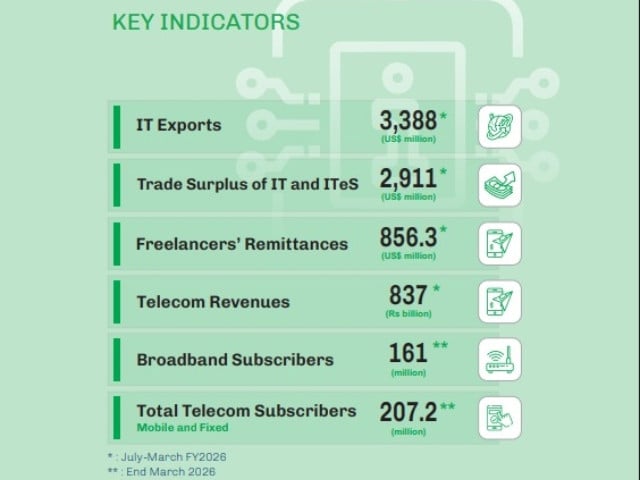







 English (US) ·