
.png)
 14 hours ago
1
14 hours ago
1
ARTICLE AD BOX
With Hormuz blockage, millions of barrels of Saudi oil are heading to Saudi Arabia's Red Sea port of Yanbu instead
Reuters
July 22, 2026
4 min read
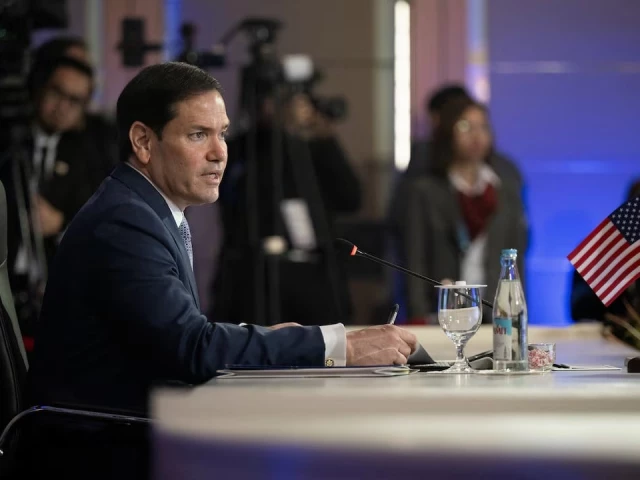
US Secretary of State Marco Rubio makes an opening statement during the ASEAN Post-Ministerial Conference with the US on the sidelines of the Association of Southeast Asian Nations (ASEAN) Foreign Ministers' Meeting in Pasay, Metro Manila, July 22, 2026—REUTERS
US Secretary of State Marco Rubio said on Wednesday that Iran was not serious about talks to end their war, as the widening conflict disrupted two of the world's most critical energy chokepoints. Four tankers carrying Saudi crude to Asia reversed course in the Red Sea on Wednesday, a day after three others had done so, following threats to block Saudi shipping from Yemen's Iran-aligned Houthis, who control the coast on the southern route out. With Iran already threatening shipping out of the Gulf through the Strait of Hormuz, millions of barrels of Saudi oil per day are heading to Saudi Arabia's Red Sea port of Yanbu instead. The northern route out via the Suez Canal adds weeks to the shipments. US attacks on Iran have expanded from the south in recent days to include central and western areas. At the same time, Tehran has hit vital water desalination and energy plants in Kuwait and says it has targeted US military assets in Kuwait, Bahrain and Jordan. "The problem we're having right now is that they're not serious about talks. If they're serious, we're serious. If they're not, then we will do what's necessary to protect our interests, and also the interests of our allies," Rubio said at a meeting of Southeast Asian foreign ministers in Manila. SECRETARY RUBIO: "We remain open to diplomacy. We remain open to working it out in a negotiated way, but right now, they don't seem to be serious about that." pic.twitter.com/XF9XfmGuqz Iran aims to strengthen its hand for talks, analyst says Mediators have presented Iran with a proposal for a 10-day ceasefire, a senior Iranian official told Reuters on Monday. Analysts said the new threat to shipping from the Houthis on Tuesday was a tactical move by Iran. "Tehran is trying to create leverage for a negotiation," said Mahmoud Shehrah, associate fellow, Middle East and North Africa Programme at Britain's Chatham House think tank. The proposal aims to salvage an interim ceasefire agreement signed by Washington and Tehran in June. Iran's Interior Minister Eskandar Momeni visited mediator Pakistan this week and asked it to continue its efforts. Pakistan strongly condemned the Houthi threat to block Saudi oil exports on Wednesday, saying that while it remained committed to dialogue, all parties should ensure the safety of shipping and respect international law. Iran has insisted on maintaining control over the Strait of Hormuz that it established during the war launched by the US and Israel on February 28. Rubio said such control would be dangerous for the world, including Southeast Asia, where many countries have territorial disputes with China in the South China Sea. US Secretary of State Marco Rubio told ASEAN that allowing Iran to have control of the Strait of Hormuz and charge a fee would set a “dangerous precedent” with repercussions beyond the Middle East. pic.twitter.com/fJHfT8lNow Oil prices up near six-week highs on fears of escalation The war has killed thousands of people across the Gulf, and Iran's squeeze on energy shipments from Gulf states has driven inflation around the world. Oil prices rose to near six-week highs on Wednesday, with benchmark Brent crude futures at almost $94 a barrel and US gasoline prices, which have dented Trump's popularity ahead of midterm elections in November, back over $4 a gallon. With no diplomatic breakthrough in sight, the US military bombed targets in Iran for an 11th straight night. Tehran residents reported hearing explosions in the early hours of Wednesday as Iran activated its air defences over the capital, Iran's semi-official Fars news agency said. Three locations in Iran's Bushehr Province, home to Iran's only nuclear power plant, were hit by US attacks early on Wednesday, an official told Iran's state news agency IRNA. That included an electricity post close to the plant. Iran's army said it struck accommodation buildings and equipment storage facilities at the US Al Azraq Air Base in Jordan, and later targeted equipment warehouses and aircraft maintenance hangars at Sheikh Isa Air Base in Bahrain using Arash suicide drones. Jordan said it had shot down four Iranian drones and intercepted six Iranian missiles. Reuters was unable to immediately verify details of the attacks. Trump renews threat to attack Iranian nuclear facility US President Donald Trump confirmed that 18 US service members had been killed so far in the war, including four in Iranian attacks on US military bases in Jordan and Iraq over the last few days. He said the Houthis, who threatened in a letter to shippers on Tuesday to attack any ships that load or discharge Saudi oil, had not yet shut the Bab el-Mandeb Strait leading into the Red Sea, and threatened to act against them if they did. A full closure of that alternative route by the Houthis could further reduce global oil supply, as it would leave most Saudi oil exports trapped. Trump renewed his threats to attack the Iranian nuclear facilities buried in a mountain at Natanz again "pretty soon". After the US bombed the facility in June 2025, he said they had been "totally obliterated". Iran pledged to retaliate.




 English (US) ·