
.png)
 1 hour ago
2
1 hour ago
2
ARTICLE AD BOX
The Foreign Office (FO) on Thursday said Pakistan’s relations with the United Arab Emirates remained unaffected by any external engagements the Gulf state may have, expressing confidence in the strength of bilateral ties. It said the relationship was based on mutual trust, adding that this sentiment was also shared in Abu Dhabi.
“Pakistan – UAE relations are strong, brotherly, built on strong foundation. We have 2.2 million-strong diaspora in the UAE. We have traditionally been friendly and cooperative in all affairs. We have a trade close to $8 billion, said FO Spokesperson Tahir Andrabi during the weekly press briefing.
He further said that there is “absolutely no question” of any negative aspersions with respect to relations between Islamabad and Abu Dhabi.
Earlier in the day, Minister of State for Interior Tallal Chaudhry said that Pakistan’s relationship with the United Arab Emirates was “absolutely fine”.
Several media outlets in recent days have reported that the Gulf country had begun a “large-scale expulsion” of Pakistani workers, particularly Shia workers, signalling a shift in Pakistan-UAE ties. The Interior Ministry has denied the claims.
Referring to India, Andrabi said that calls in India for dialogue with Pakistan were a positive development and expressed hope that “warmongering” and “belligerence” being witnessed in the neighbouring country for a long time would “fade away”.
The journalist who asked the question mentioned various statements, including a recent one by former Indian army chief Gen (retired) Manoj Naravane, who supported the Rashtriya Swayamsevak Sangh (RSS) secretary general’s remarks calling for keeping the window for dialogue between Islamabad and New Delhi open.
In response to the question, Andrabi said: “The voices within India calling for dialogue are obviously a positive development; we hope that sanity will prevail in India, and warmongering, the belligerence that has been emanating for the past several months and even beyond, for past years, will fade away and pave the way for more such voices.”
When asked about reports in the Indian media about backchannel talks going on between New Delhi and Islamabad, the FO spokesperson replied: “About track two or backchannel – well I am not aware of that and do not wish to comment on those. If I were to comment, there would be no backchannel. Backchannel or track two, the name is self-explanatory.”
In the recent past, ties between India and Pakistan particularly deteriorated after New Delhi blamed Islamabad without evidence for an attack on tourists in occupied Kashmir’s Pahalgam in April 2025. For its part, Pakistan strongly denied the allegations and called for a neutral investigation.
Two days after the Pahalgam attack, India had taken a series of aggressive measures against Pakistan, including unilaterally suspending the critical Indus Waters Treaty (IWT). Pakistan retaliated by suspending all kinds of trade, closing its airspace for Indian flights and shutting down the Wagah border.
Subsequently, New Delhi launched deadly overnight air strikes on Pakistan on May 6 over allegations about the Pahalgam attack. In retaliation, Pakistan Air Force downed several Indian planes in air-to-air combat. The initial tally of the downed jets was announced as five and later raised to eight.
After tit-for-tat strikes on each other’s airbases, it took American intervention on May 10 for both sides to finally reach a ceasefire.
‘Misrepresented’
During the weekly briefing Andrabi also said that certain media reports “misrepresented” Chinese Foreign Minister Wang Yi’s recent remarks to Deputy Prime Minister and FM Ishaq Dar, affirming the call was held with cordiality.
The clarification comes after Chinese state media Xinhua reported that during his call with Dar on Tuesday, Wang expressed hope that “Pakistan can step up mediation efforts” between the United States and Iran.
Addressing the matter, Andrabi said, “Some reports suggested that the Chinese side urged us to enhance the mediation efforts, implying as if Pakistan was being asked to sort in a ‘do more’ paradigm. So news coverage by some of local newspapers conveyed the same impression.
“I wish to place on record that such reports somewhat misrepresent the call in both letter and spirit,” he added, asserting that the call was held with “traditional warmth and cordiality”.
Andrabi said FM Wang appreciated “Pakistan’s constructive mediation role and expressed full support for its efforts”, echoing what was reported by Xinhua as well.
“Wang reiterated China’s principled position and commended Pakistan for facilitating US-Iran talks and helping extend the temporary ceasefire. He expressed hope that Pakistan will maintain confidence and contribute to restoring regional peace at an early date, which is also the common aspiration of the international community,” the report read.
China will continue to support Pakistan’s mediation efforts and make its own contribution toward this end, Wang was quoted as saying.
In its statement on the call, the FO had also said Wang reiterated Beijing’s appreciation and support for Pakistan’s role as a mediator.
It added that both top diplomats “underscored the importance of continuing a durable ceasefire and ensuring normal passage through the Strait of Hormuz”.
Despite signs that negotiations between the US and Iran have stalled after President Donald Trump rejected Tehran’s latest response to a proposed settlement framework, Pakistan has remained engaged in mediation efforts.
A series of diplomatic contacts made earlier this week suggested that regional and international actors are still attempting to prevent the situation from sliding back toward open hostilities.
Even as military pressure and fears of renewed confrontation continued to shape the crisis, Pakistan’s diplomatic engagement has persisted despite a far more complicated scenario.
On Monday, US Chargé d’Affaires Natalie Baker met with Dar to discuss the evolving regional situation. The same day, Dar spoke with Saudi FM Faisal bin Farhan Al Saud on a call, with FO saying that the latter “reiterated support for Islamabad’s efforts aimed at promoting regional peace and stability”.
Also on Monday, United Nations Secretary General’s Personal Envoy for the Middle East Conflict Jean Arnault also met Dar, who briefed him on recent developments and Pakistan’s continuing engagement with the parties concerned.
Seamen still in Somali pirates’ captivity
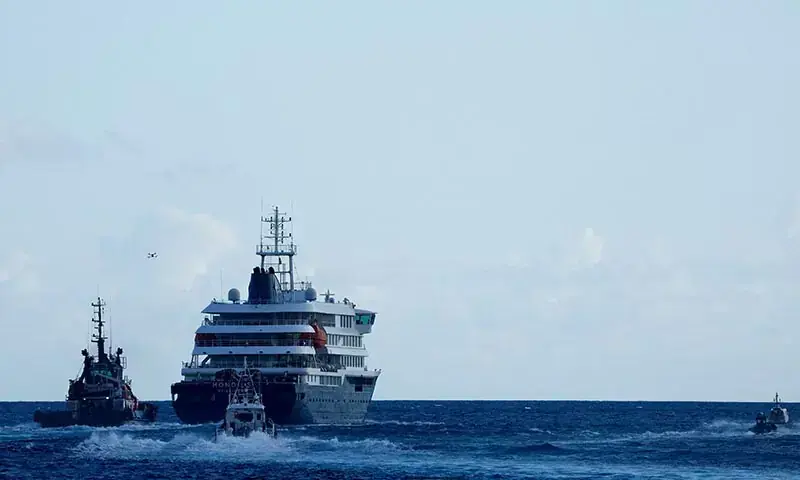
The FO spokesperson was also asked about the captivity of Pakistanis aboard an oil tanker seized by Somali pirate.
The MT Honour 25, a Palau-flagged product tanker, was seized on April 21, approximately 30 nautical miles off Somalia’s Puntland region with 17 crew members aboard, 10 of them Pakistani.
Andrabi said the “individuals are still with the Somali pirates. Unfortunately, their release has not been secured as yet”.
However, he added that a two-member team from the Pakistani embassy in Djibouti had gone to Somalian capital Mogadishu.
“It has held important meetings with the Somali Ministry of Foreign Affairs, Somali Ministry of Defence, with the Somali naval authorities, and maritime authorities.
“We were told [our] nationals are safe and are being provided food,” he said. “They are in harsh living conditions, but at least we were assured of their safety.”
The FO spokesperson further stated that they had been informed that the pirates were negotiating directly with the ship owner, who had been constantly communicating the details to Somali government officials.
“We (our team) spoke with this official who is in touch with the ship owner. The dynamics of this incident of piracy is that the pirates, who are Somali nationals, do not negotiate with the governments of the captives. They negotiate only with the shipowners. So, it’s incorrect to say that Pakistan government can negotiate or will negotiate,” he added.
The FO spokesperson also said that piracy had been a long-standing problem.
“We feel for the safety of our people. We are very keen for their quick repatriation. We are in touch with the Somali authorities and we will continue to do so. I can assure you that this matter is high on our radar and agenda, in terms of our bilateral with Somalia, and is a pressing, emergent humanitarian imperative,” he added.




 English (US) ·