
.png)
 10 hours ago
1
10 hours ago
1
ARTICLE AD BOX
Says launch of IBI headquarters marks transformative milestone in Pakistan-China All-Weather Strategic Partnership
APP
May 13, 2026
4 min read
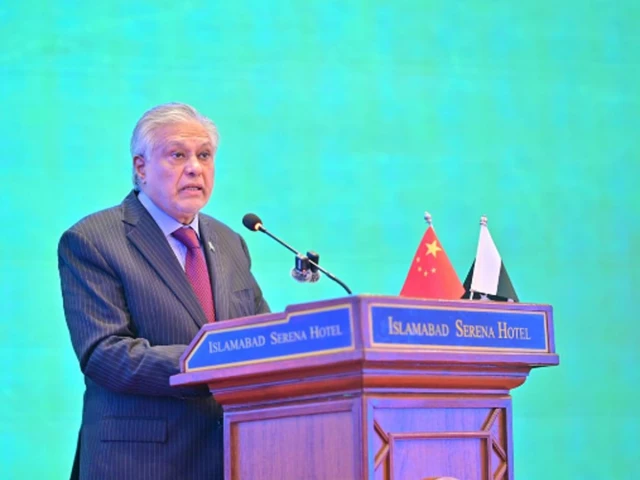
Deputy Prime Minister Ishaq Dar. Photo: APP
Deputy Prime Minister and Foreign Minister Ishaq Dar announced on Wednesday that PM Shehbaz Sharif would undertake an official visit to China from May 23-26, saying the visit would include a vibrant business-to-business forum aimed at further strengthening commercial ties. FM Dar made the announcement during the launch of the IBI Pakistan Digital Economy Headquarters in Islamabad, describing it as a powerful symbol of the enduring Pakistan-China partnership and a new chapter in digital collaboration. He said that the launch of the IBI headquarters marked a transformative milestone in the Pakistan-China All-Weather Strategic Partnership. Highlighting PM Shehbaz’s vision to establish Pakistan as a regional hub for digital innovation, he said that the Pakistan-China partnership was transitioning from physical infrastructure, such as the Karakoram Highway and CPEC energy projects, toward intelligent infrastructure, AI, ICT, and digital connectivity. “Today, we are moving from roads to networks, from physical infrastructure to digital architecture. We are building a digital Silk Road today, beginning with the launch of the IBI headquarters in Islamabad,” he said. Deputy Prime Minister / Foreign Minister Senator Mohammad Ishaq Dar @MIshaqDar50 addressed as keynote speaker today at the launch of IBI Pakistan Digital Economy Headquarters.
He highlighted Prime Minister Shehbaz Sharif’s @CMShehbaz vision of making Pakistan a regional digital… pic.twitter.com/sYoDQAcGNU DPM Dar told the gathering that under CPEC 2.0, cooperation was expanding beyond traditional sectors into digital transformation, smart cities, and climate resilience. Sharing optimistic economic indicators, including a fall in inflation, rising GDP and a dive in the policy interest, he reaffirmed the government’s commitment to returning Pakistan to the roadmap of becoming a top-20 global economy. With the world’s fifth-largest population and a rapidly growing youth demographic, the deputy prime minister emphasised that Pakistan was no longer “waiting for its moment” but had reached a stage of immense IT potential and global competitiveness. Read More: Pak-China sign $13b in MoUs, JVs in 2 years He welcomed Beijing United Information Technology (IBI) to Pakistan, noting that its platform — serving millions of enterprises across 100 industrial sectors in China — reflected strong international confidence in Pakistan’s economy. DPM Dar also lauded the efforts of Pakistan’s Ambassador to Beijing Khalil Hashmi for professionally facilitating B2B forums, noting that 30% of the $10 billion in MOUs signed during recent visits to China had already been translated into finalised projects. Earlier, in his address, Ambassador Khalil Hashmi explained that if Amazon and Alibaba were the e-commerce giants of consumer goods, IBI was the e-commerce giant of industrial goods. He said that IBI was a Fortune 500 company listed on the Shanghai Stock Exchange. Hashmi said that the IBI launch represented a massive opportunity, especially for small and medium-sized enterprises (SMEs) in Pakistan, offering a gateway to a vast Chinese market—spanning agriculture, aquaculture, and industrial goods—and, through China, a path to the rest of the world. He said that by deepening digital industrial cooperation and synchronising government and corporate resources, IBI had successfully translated high-level leadership directives into tangible results. “Today, we are witnessing the convergence of two transformative forces: the enduring friendship between Pakistan and China and the unstoppable rise of the digital economy,” he added. Information Minister Shaza Fatima Khawaja and Special Assistant to PM Haroon Akhtar Khan also addressed the launching ceremony. Last month, President Asif Ali Zardari also completed a five-day visit to China, during which both countries signed multiple memorandums of understanding (MoUs) aimed at strengthening bilateral cooperation in desalination, agricultural technology, and the tea industry. This move is expected to boost investment, technology transfer, and economic ties between the two countries. The first MoU was concluded between the Government of Sindh and Lucion Environmental Technology Group for collaboration on a seawater desalination project in Karachi. The project aims to enhance the city's water supply by making seawater usable through modern technology. The second MoU focused on cooperation in agricultural technology. Sharjeel Inam Memon signed it on behalf of the Sindh government and Chen Zhixin, chairman of Longping High-Tech Information Company, signed for the Chinese side. The third MoU, relating to the tea sector, was signed between MESKAY & FEMTEE Trading Company, Hunan Tea Group and Jiaolong International Technology in Hainan. Earlier in January, Pakistan and China agreed to align their development strategies and build an upgraded version of the China-Pakistan Economic Corridor, known as CPEC 2.0, during wide-ranging talks in Beijing that also covered political ties, security cooperation and regional and international issues. As part of their economic engagement, Pakistan and China agreed to develop an upgraded CPEC, a pioneering project of the Belt and Road Initiative. The two sides said the new phase would focus on the key sectors of industry, agriculture and mining, promote the building and operation of Gwadar Port, ensure the smooth passage of the Karakoram Highway, and enhance Pakistan’s capacity for sustainable development. They also agreed to deepen cooperation in trade and investment, information technology, science and technology, cybersecurity, technical and vocational training and education, and people-to-people and cultural exchanges. The two sides stated that the year-round opening of the Khunjerab Pass would facilitate two-way trade and further strengthen people-to-people contacts. They also welcomed third-party participation in CPEC cooperation in accordance with the modalities agreed by both countries.






 English (US) ·