
.png)
 2 months ago
50
2 months ago
50
ARTICLE AD BOX
Iran war overshadows Trump's China visit as peace talks stall
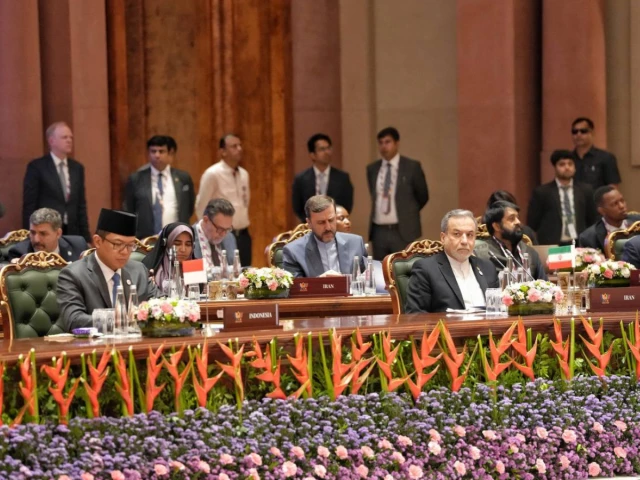
Iran's foreign minister, Abbas Araghchi, has joined counterparts from BRICS member states as the bloc's high-level foreign ministers' meeting officially commences. PHOTO: PRESSTV ON X
Tehran has called on BRICS members to condemn US and Israeli aggression against Iran, Iranian foreign minister Abbas Araghchi said in a statement. Araghchi said that the West's "false sense of superiority" must be shattered by the Global South. The Iranian foreign minister is currently in New Delhi attending the BRICS foreign ministers meeting, according to Iranian media outlet Mehr news agency. Iranian Foreign Minister Seyyed Abbas Araghchi left Tehran for India’s capital of New Delhi on Wednesday afternoon to attend the BRICS Foreign Ministers’ meeting. pic.twitter.com/XkYfa28hpM While speaking to Press TV at the BRICS summit, Araghchi said the main obstacle to in the Strait of Hormuz was the US blockade. Iran war overshadows Trump's China visit as peace talks stall US President Donald Trump is expected to ask China to help end the costly and unpopular Iran war in discussions with President Xi Jinping in Beijing on Thursday, with peace talks stalled and the global economic cost of the conflict increasing. The US-Israeli war on Iran looms large over Trump's visit to China, the first by a US president since his last trip there in 2017, although analysts say he is unlikely to get the support he wants. More than one month after a tenuous ceasefire took effect, diplomatic efforts have failed to make progress towards resolving a war that has cost thousands of lives, reshaped alliances in the Middle East and driven up prices of oil and other key commodities around the world. Washington has called for Tehran to scrap its nuclear programme and lift the chokehold it has placed on the Strait of Hormuz, a key shipping lane through which about 20% of the world's oil and liquefied natural gas travelled before the war began on February 28. Iran has demanded compensation for war damage, an end to the US blockade of Iranian ports and a halt to fighting on all fronts, including in Lebanon, where Israel is battling Iran-backed Hezbollah. Trump has dismissed Tehran's positions as "garbage." Read: Iran won't allow US weapons to transit Hormuz Trump's visit to China, which maintains close ties with Tehran and is a major buyer of Iranian oil, comes as the war fuels inflation at home and raises the risk that voters will blame Trump's Republican Party in November's midterm elections. The United States hopes to convince China "to play a more active role in getting Iran to walk away from what they're doing now and trying to do now in the Persian Gulf," U.S. Secretary of State Marco Rubio told Fox News' "Hannity" programme in a clip released on Wednesday. "We've made clear to them that any support for Iran would obviously be detrimental for our relationship. That obviously is going to come up in this conversation on trade," Rubio also said in the interview that took place on board Air Force One en route to China. The Trump administration said on Tuesday that senior U.S. and Chinese officials had agreed last month that no country should be able to charge tolls on traffic through the region, as Iran has threatened to do. China did not dispute that account. On Wednesday, a Chinese supertanker carrying 2 million barrels of Iraqi crude sailed through the Strait of Hormuz, ship-tracking data showed, marking the third known passage by a Chinese oil tanker through the channel since the war began. Other countries are exploring shipping arrangements similar to Tehran's deals with Iraq and Pakistan, sources said, potentially entrenching Tehran's control of the waterway through which fertilisers, petrochemicals and other bulk commodities vital to global supply chains normally flow. A Panama-flagged crude oil tanker managed by Japanese refining group Eneos 5020.T, opens new tab has passed through the Strait of Hormuz, ship-tracking data from LSEG showed on Thursday, the second instance of such a Japan-linked ship traversing the strait. Japan relied on the Gulf for about 95% of its oil imports before the war. Reshaping alliances Israel said Prime Minister Benjamin Netanyahu secretly travelled to the UAE in March for talks with Sheikh Mohammed bin Zayed, which Israel said resulted in a "historic breakthrough" in relations between the two. They re-established ties in 2020 as part of the Trump-backed Abraham Accords, and the relationship has strengthened since the UAE came under Iranian attack. But the UAE's foreign ministry denied the trip took place, saying "any claims regarding unannounced visits or undisclosed arrangements are entirely unfounded". Iran, which has struck the UAE more than its other Gulf neighbours in response to the U.S.-Israeli attacks, warned the Emiratis against becoming an enemy. "Enmity with the Great People of Iran is a foolish gamble. Collusion with Israel in doing so: unforgivable. Those colluding with Israel to sow division will be held to account," Foreign Minister Abbas Araqchi wrote on X. Separately, Reuters reported that Saudi fighter jets bombed Iran-backed militias in Iraq, part of a broader pattern of military responses involving Gulf nations during the war that have remained hidden. Retaliatory strikes were also launched from Kuwait into Iraq, sources said. U.S. Vice President JD Vance said on Wednesday he believed progress was being made in negotiations to end the war. "The fundamental question is, do we make enough progress that we satisfy the president's red line?" Vance told reporters at the White House. "And the red line is very simple. He needs to feel confident that we put a number of protections in place such that Iran will never have a nuclear weapon." Iran denies seeking nuclear weapons.




 English (US) ·