
.png)
 8 hours ago
1
8 hours ago
1
ARTICLE AD BOX
Her death and exam-related suicides fuelled mass protests demanding accountability from Modi's government
Reuters
July 25, 2026
6 min read
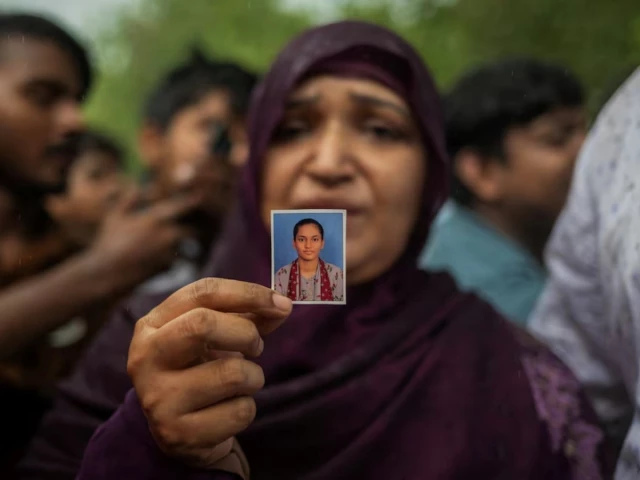
Habibunnisa, mother of Sheikh Sana, 19, an aspirant doctor who took her own life before the National Eligibility cum Entrance Test (NEET) exam retest, shows a picture of her daughter at the Cockroach Janta Party (CJP) protest site, a day after thousands of protesters marched toward parliament demanding the resignation of Education Minister Dharmendra Pradhan over NEET examination paper leaks, at Jantar Mantar in New Delhi, India, July 21, 2026. REUTERS
The prospect of retaking one of India's most competitive exams was so daunting for 19-year-old Sheikh Sana that a day before the test, the pressure became unbearable. Instead of preparing again for the exam, she wrote "I am sorry" on a plain sheet of paper and took her own life, her family said. Her death, along with the suicides of other aspiring students who sat medical college entrance exams only to face retakes after it emerged that test papers had been leaked, has become a focus for thousands of young protesters demanding accountability from Prime Minister Narendra Modi's government. On Saturday, Education Minister Dharmendra Pradhan resigned over the protests. About two months of protests have evolved from demands for action over the leaks into a broader expression of frustration over education, opportunity and accountability in a country where 65% of the population is under the age of 35. More than two million students sat the pen-and-paper exam, known as the National Eligibility-cum-Entrance Test (NEET), in May. After the leak came to light, the government launched an investigation into the test-selling scheme, cancelled the release of the results and ordered a retake in June, forcing candidates back into intense test preparation. Read More: Modi's education minister resigns in win for Indian youth protesters Sana's family, as well as the families of two other students who took their own lives, attributed their deaths to the voiding of the first exam and the uncertainty that followed. "The fear killed her. The fear of re-NEET," Sana's father, Sheikh Jaffar Hussain, told Reuters at New Delhi's Jantar Mantar protest site, where students have been demanding accountability over the government's handling of the affair. The government has not commented on the deaths of the exam candidates. Police officials in Rajasthan, Telangana and Gujarat told Reuters they had registered as suicides the deaths of Sana and two other students whose parents Reuters interviewed, and that the cases were still under investigation. They did not comment on the reason for the deaths, which Reuters was unable to independently confirm. In mid-May, India's federal Central Bureau of Investigation (CBI) announced that teachers and agents at private tuition centres had leaked the exam paper, charging students large sums for access to the questions. The CBI has arrested 13 suspects, including a doctor and several teachers, over the leaks. Modi said in a video message on Thursday that he was pained by the paper leaks and promised strict action against those responsible, including by trying them in fast-track courts. "I know that paper leaks are not an ordinary issue. And for millions of students and their guardians, this is painful," he said. Surging protest movement This week, tens of thousands protested in central Delhi, and police used batons and tear gas to disperse crowds. Opposition lawmakers disrupted parliament as they echoed protesters' calls for the resignation of Education Minister Dharmendra Pradhan. Rahul Gandhi, leader of the main opposition Congress Party, told reporters that exam paper leaks had gone unpunished, and that there had been more than 150 leaks over the past decade. Pradhan and his ministry did not respond to a request for comment on past leaks. The Cockroach Janta Party (CJP), the Gen Z movement leading the protests in the capital, says 21 students died by suicide in cases it believes were linked to the exam fiasco. Reuters could not independently verify the CJP's numbers. The offices of the prime minister, education minister, and the top government spokesperson did not respond to requests for comment from Reuters on the protests and the student deaths. On Tuesday, Pradhan said the government was committed to discussing NEET and addressing youth concerns. In a post on X on Saturday announcing his resignation, he said: "I deeply respect the aspirations, feelings, and legitimate expectations of the country's youth." Some political analysts say the unrest, which has spread to other regions of India, presents a challenge for a government that has often described India's youthful population as one of the country's biggest strengths. "When young people are on the streets of Delhi protesting against a malfunctioning education system, it acquires much larger significance," said Sabyasachi Basu Ray Chaudhury, a political science professor at Rabindra Bharati University in Kolkata. However, analysts also say it will be hard to dent Modi's popularity. In his 12 years in office, he has weathered a series of major protest movements, including over a new citizenship law and agricultural reforms, without lasting electoral damage. Fierce competition for education For thousands of Indian families, the medical college entrance exam is seen as a gateway to financial security, social mobility and prestige in a country where competition to gain professional qualifications is fierce and opportunities can be scarce. Also Read: Pakistan tells UNSC Kashmir is 'not India's internal matter' Despite rapid economic growth, India's official youth unemployment rate stood at 9.9% last year, far above the overall rate of 3.1%. Only around 6% of candidates secure a place in medical college through the test, according to government data. Families often spend years of savings or borrow heavily to fund tuition, accommodation and study materials, in the hope that a child will win admission to medical school. In one such case, Rajesh Kumar, a farmer in Jhunjhunu district in the northwestern state of Rajasthan, said he sold land worth 2.8 million rupees ($29,000) and took a bank loan of 1.1 million rupees to support his son Pradeep Kumar's preparations. The 22-year-old student had dreamed of becoming a doctor since childhood and moved to the coaching hub of Sikar to study for the exam, his father said. He died by suicide on May 15, days after the release of the exam results was cancelled. Sitting on a red plastic chair outside his modest brick home, with a young calf tethered nearby, Kumar told Reuters the cancellation shattered his son. "We are farmers and hardly educated, but my son always wanted to become a doctor," he said. Kumar said he blamed what he called a "failure of the system" for his son's death and that he would not immerse his son's ashes in the Ganges, part of Hindu last rites, until Education Minister Pradhan resigned. The CJP and the Congress Party have demanded compensation for the families of students who took their own lives. The government hasn't offered any, but Kumar, like other relatives Reuters interviewed, said he was not seeking money. "I want accountability," he said. ‘He wasn’t able to fight more’ Another student, 17-year-old Kahaan Patel, died in Gujarat, Modi's home state, days before the retake of the exam took place in June. His father, Prashant Patel, said his son had hoped to study medicine and later go to the United States for higher education. He said that after the retest was announced, his son tried to prepare again, but could not cope with the uncertainty. "He wasn't able to fight more, so he ended it," Patel told Reuters. Education activist Nandita Narain, a former president of the Delhi University Teachers' Association, said the protests reflected concerns about the pressure on students competing for college places, and the growing role of often costly private coaching and commercial interests in education. "The youth of India have finally awakened to the seriousness of the problem," Narain said. "The anger which was building up for some time has come to the surface." Back at the Delhi protest site, two photographs of students who died by suicide were placed on the stage as protesters continued to chant slogans demanding answers.


 English (US) ·