
.png)
 1 month ago
43
1 month ago
43
ARTICLE AD BOX
• Scraps US team trip to Pakistan • Says cancellation does not signal return to fighting • Traffic through Strait r
Reuters
April 26, 2026
5 min read
WASHINGTON:
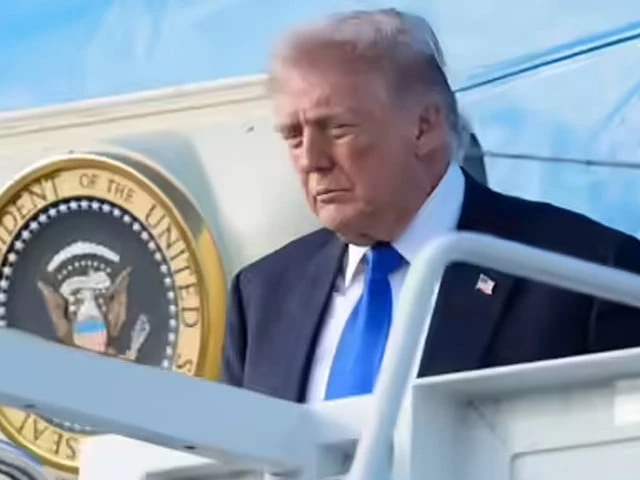
President Donald Trump cancelled a trip by two US envoys to Iran war mediator Pakistan on Saturday, dealing a new setback to peace prospects. Trump told reporters in Florida that he decided to call off the planned visit by US envoys Steve Witkoff and Jared Kushner because the talks in Islamabad involved too much travel and expense, and Iran's latest peace offer was not good enough for him. "We're not going to spend 15 hours in airplanes all the time going back and forth to be giving a document that was not good enough, and so we'll deal by telephone, and they can call us anytime they want," Trump said speaking to reporters outside Air Force One in Florida before before traveling back to Washington, DC. He added Iran had improved an offer to resolve the conflict after he cancelled the visit, "but not enough". "They gave us a paper that should have been better, and interestingly, immediately, when I canceled it, within 10 minutes, we got a new paper that was much better," Trump told the reporters. Trump also praised Pakistan's leadership. "I think Pakistan is terrific and the field marshal is fantastic. I think the prime minister of Pakistan's great, and they'd like to see something happen," Trump told reporters. In a social media post, Trump also wrote there was "tremendous infighting and confusion" within Iran's leadership. "Nobody knows who is in charge, including them. Also, we have all the cards, they have none! If they want to talk, all they have to do is call!!!" he posted on Truth Social. Tehran has ruled out a new round of direct talks with the United States and an Iranian diplomatic source said his country would not accept Washington's "maximalist demands". Trump said the cancellation does not mean the resumption of the war. "No. It doesn't mean that. We haven't thought about it yet," Trump said in a call with Barak Ravid, an Axios reporter and CNN contributor, when asked whether the decision to not send special envoy Steve Witkoff and Trump's son-in-law Jared Kushner to Pakistan should be interpreted as a step toward another round of fighting. President Donald Trump's abrupt decision to scrap his envoys' planned trip to Pakistan - only a day after announcing it - was a clear indication the American criteria for another round of talks haven't yet been met. US officials had been looking for two things from Iran in the 14 days since the last set of marathon negotiations ended without a deal: A negotiating proposal that addressed Trump's red lines on its nuclear program, and a clearer sense from Tehran of who is in charge. A day ago, it appeared as if there had been movement. "We've certainly seen some progress from the Iranian side in the last couple of days," press secretary Karoline Leavitt said at the White House yesterday. But whatever progress had been conveyed by the Iranians appeared insufficient. Trump decided to cancel the trip about an hour after Iran's foreign minister, Abbas Araghchi, departed Islamabad, where he was updating Pakistani officials on Iran's latest proposal. American officials say they remain concerned that divisions between moderates and hardliners within the Iranian regime are hampering Tehran's ability to coalesce around a negotiating position. "There is tremendous infighting and confusion within their 'leadership,'" Trump wrote on Truth Social. "Nobody knows who is in charge, including them." That leaves the US and Iran still without a deal, or even any indication of moving toward one. Trump insists this is Iran's problem, not his. "We have all the cards, they have none!" he wrote. Still, for all Trump's stated indifference on reaching a deal soon, it remains unclear how the war will end - and how the Strait of Hormuz will reopen - without one. Washington and Tehran are at an impasse as Iran has largely closed the Strait of Hormuz, which normally carries one-fifth of global oil and liquefied natural gas shipments, while the US blocks Iran's oil exports. The conflict, in which a ceasefire is in force, began with U.S.-Israeli airstrikes on Iran on February 28. Iran has since carried out strikes against Israel, U.S. bases and Gulf states, and the war has pushed up energy prices to multi-year highs, stoking inflation and darkening global growth prospects. Araqchi "explained our country's principled positions regarding the latest developments related to the ceasefire and the complete end of the imposed war against Iran", said a statement on the minister's official Telegram account. Asked about Tehran's reservations over US positions in the talks, an Iranian diplomatic source in Islamabad told Reuters: "Principally, Iranian side will not accept maximalist demands." White House press secretary Karoline Leavitt had said the US had seen some progress from the Iranian side in recent days and hoped more would come over the weekend, while Vice President JD Vance was ready to travel to Pakistan as well. Vance led a first round of unsuccessful talks with Iran in Islamabad earlier this month. Strait of Hormuz Traffic through the choked Strait of Hormuz remains significantly lower than pre-war levels. Only a handful of vessels appear to have traversed the crucial waterway so far today, according to tracking data. The channel, through which one-fifth of global crude oil flows, has become a key focal point of the US-Israeli war with Iran, with spiraling economic impacts around the world. Tehran and Washington have launched separate blockades of the waterway, with Iran attacking what it calls "hostile" vessels and the US targeting ships from Iranian ports. Data from MarineTraffic, a maritime intelligence provider, shows an oil products tanker named Oceanjet, owned by an Indian company, and an oil and chemical tanker called Lumina Ocean crossed the waterway in recent hours. A Russia-flagged yacht has also sailed through the strait. CNN cannot independently verify the journeys as shipping data can sometimes show irregularities due to signal gaps and spoofing – the transmission of false signals to mislead tracking systems. (With input from News Desk)



 English (US) ·