
.png)
 18 hours ago
1
18 hours ago
1
ARTICLE AD BOX
• Regional ministers seek curbs on missiles and proxies • Rubio says final settlement must protect Gulf stability •
Agencies
June 26, 2026
5 min read
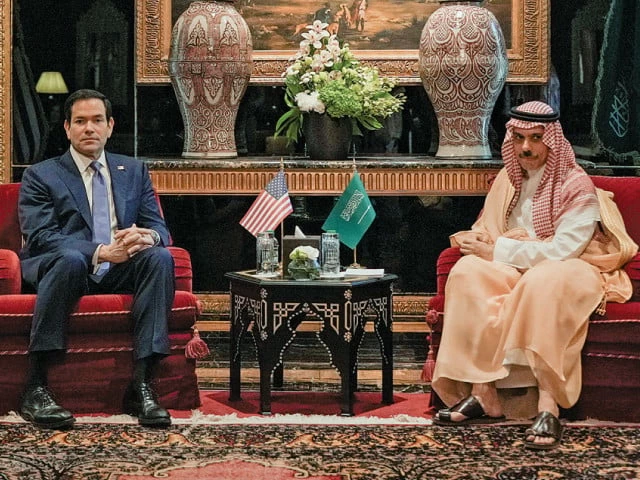
US Secretary of State Marco Rubio meets Saudi Foreign Minister Faisal bin Farhan Al Saud in Manama, Bahrain. Photo: REUTERS
LONDON/
MANAMA:
The United States has declared that it remains committed to reaching a comprehensive agreement with Iran but warned that no deal would be accepted if it undermines the security of Gulf allies or allows Tehran to impose charges on shipping through the Strait of Hormuz. US Secretary of State Marco Rubio, speaking in Bahrain during a regional tour on Thursday, said Washington wanted an agreement with Tehran but "not at any price", stressing that any final settlement must safeguard the stability, prosperity and security of Gulf partners. His remarks came as negotiations between the United States and Iran resumed following a preliminary agreement aimed at ending months of conflict that erupted after a major US-Israeli military campaign against Iran began on February 28. The preliminary accord has opened negotiations expected to address Iran's nuclear programme, sanctions relief and the future of global energy flows through the Strait of Hormuz. However, it remains uncertain whether the talks will also include Tehran's ballistic missile programme and its support for allied groups across the Middle East, issues long regarded by Gulf Arab states and Israel as central security concerns. Speaking during a visit to Pakistan this week, Iranian President Masoud Pezeshkian said that Iran's missile programme remains off the table, adding that it was not the part of the Islamabad Memorandum of Understanding, therefore, it will not be discussed at any forum. In Manama, the foreign ministers of the Gulf Cooperation Council (GCC) states issued a joint statement after meeting Rubio, insisting that lasting regional peace required addressing "the full spectrum of Iran's threats", including its ballistic missiles, drones and support for proxies. The ministers also declared that any future trade and investment with Iran would remain conditional and reversible, depending on Tehran's compliance with the MoU, its adherence to any final agreement and an end to destabilising regional behaviour. Rubio echoed those concerns, saying Washington would not support any arrangement that compromised the interests of its Gulf partners. "We want a deal, we don't want a deal at any price," Rubio said. The United States wanted to ensure that no element of the agreement undermined regional security or prosperity, said Rubio, who focused his visit on the future of the Strait of Hormuz, through which roughly one-fifth of global oil consumption passes each day. Although the waterway has reopened under the MoU, Tehran has since proposed introducing maritime service charges for vessels using the passage, while Iran's Revolutionary Guards warned that unauthorised crossings would be dealt with. Washington has rejected any attempt to levy transit charges. Rubio said that Hormuz is an international waterway. "International waterways do not belong to any nation state. This is a foundational principle in the world today, without which the world would be in total chaos." The GCC ministers also stressed that free, unconditional and unrestricted navigation through the Strait remained essential for regional and global economic stability. Under the MoU, the Strait remains open toll-free for 60 days. Iranian Foreign Minister Abbas Araghchi, meanwhile, spoke with Oman's Foreign Minister Badr Albusaidi. Writing on X after the talks, Araghchi said Tehran and Muscat were determined to continue consultations with neighbouring countries. Araghchi wrote that Iran and Oman would hold further discussions to define the future administration and maritime services in the Strait of Hormuz following recent understandings reached between the two countries. Earlier this week Oman and Iran said that both countries were examining possible charges for maritime services provided in the waterway. But in the Manama meeting, Albusaidi reassured Gulf states that future arrangements for the Strait would not include transit tolls. Under the MoU signed last week between Tehran and Washington, commercial vessels may continue passing through the strait free of charge for 60 days but neither side has clarified what arrangements will apply once that period expires. Oman has announced a temporary shipping route running close to its coastline, saying it had been coordinated with the International Maritime Organization (IMO), the United Nations agency responsible for maritime safety. Iran later criticised the new corridor in a statement issued by the Revolutionary Guards, warning that routes established without Tehran's coordination posed safety risks and would not be accepted. The British maritime security agency UKMTO reported on Thursday that a cargo vessel sailing about 7.5 nautical miles off Oman's coast was struck on its starboard side by an unidentified projectile, damaging its bridge but causing no casualties. Two US officials later told Reuters that Iran had fired on the vessel. Earlier, British maritime security company Ambrey reported that the Revolutionary Guards had ordered two Panama-flagged ships to alter course while transiting the strait. The incident prompted the International Maritime Organization to suspend a voluntary evacuation programme launched earlier this week to help hundreds of stranded commercial vessels and thousands of seafarers leave the Gulf safely. Despite continuing security concerns, oil exports through the Strait of Hormuz have risen sharply since the ceasefire reopened the route. Data showed crude movements reached their highest level since the conflict began, though overall traffic remains well below pre-war levels. US-Iran negotiations Politically, Tehran has projected confidence following the conflict. Iran has vowed not to relinquish control over the Strait of Hormuz and has described the preliminary agreement ending hostilities as "a declaration of America's defeat". US President Donald Trump, after meeting NATO Secretary-General Mark Rutte at the White House, expressed optimism over the technical level negotiations in Switzerland, saying they were "doing great". Trump has also requested nearly $88 billion in supplemental funding, largely to cover the costs of the conflict, even as members of Congress urged him to avoid further military action without explicit legislative approval. Iran also criticised NATO after Rutte reaffirmed the alliance's support for the United States during the conflict. Foreign ministry spokesman Esmaeil Baghaei accused the alliance of complicity in "an unlawful war". Rubio and mediator Pakistan said technical negotiations between the United States and Iran were expected to resume in the coming days following an initial round of talks held in Switzerland.




 English (US) ·