
.png)
 3 months ago
51
3 months ago
51
ARTICLE AD BOX
Pakistan played a vital role in the US Iran ceasefire 2026. Prime Minister Shehbaz Sharif and Field Marshal Asim Munir convinced President Donald Trump to suspend attacks on Iran for two weeks. Their timely diplomacy led Iran to reopen the Strait of Hormuz. Talks now begin Friday in Islamabad.
President Donald Trump announced the US Iran ceasefire late on April 7, 2026. He acted directly after conversations with Pakistan’s Prime Minister Shehbaz Sharif and Field Marshal Asim Munir. Trump halted a planned devastating strike that night. He called it a double-sided ceasefire in exchange for Iran’s complete, immediate, and safe reopening of the Strait of Hormuz.
Pakistan’s leaders proposed the two-week pause as a goodwill gesture. Sharif and Munir urged both sides to step back and choose diplomacy. Their efforts prevented further escalation hours before the deadline. Trump publicly credited Pakistan for the breakthrough in his Truth Social post.
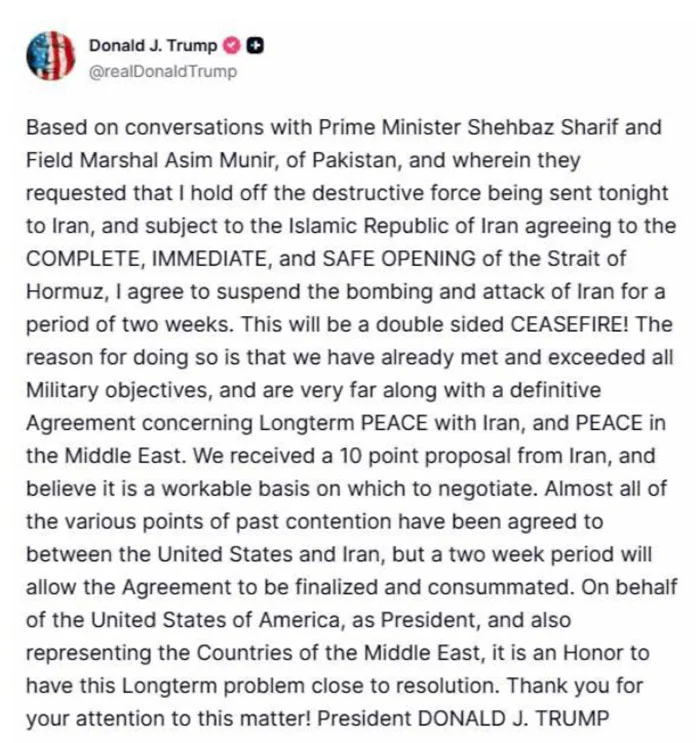
Iran accepted the US Iran ceasefire through its Supreme National Security Council. Tehran will coordinate safe vessel passage through the Strait of Hormuz via its armed forces. The waterway carries about 20% of global oil. Under the deal, Iran and Oman may charge transit fees.
The US Iran ceasefire builds on Iran’s 10-point proposal delivered through Pakistan. Trump described it as a workable basis for negotiations. Both sides already reached consensus on most issues. The two-week window allows them to finalize a permanent agreement. Points include ending the war, US non-aggression guarantees, sanctions relief, reconstruction support, and regulated passage through the Strait of Hormuz.
Pakistan hosts US and Iranian delegations for talks starting Friday, April 10, in Islamabad. Analysts praise Pakistan’s unique trusted channel between Washington and Tehran. This mediation highlights Pakistan’s positive contribution to regional stability.
Markets responded quickly
Oil prices fell below $100 per barrel after news of the Strait of Hormuz reopening. The conflict began in February 2026 with US-Israel actions against Iran. Iran responded with missiles and restricted the strait.
Trump stated that US military objectives were met and surpassed. He framed the US Iran ceasefire as a step toward long-term peace in the Middle East. Pakistan’s role helped bring the sides closer to the emerging Islamabad Accord.
The two-week US Iran ceasefire remains short. Success depends on full compliance with Strait of Hormuz reopening and any regional aspects, including Lebanon. Islamabad talks will shape the outcome.




 English (US) ·